
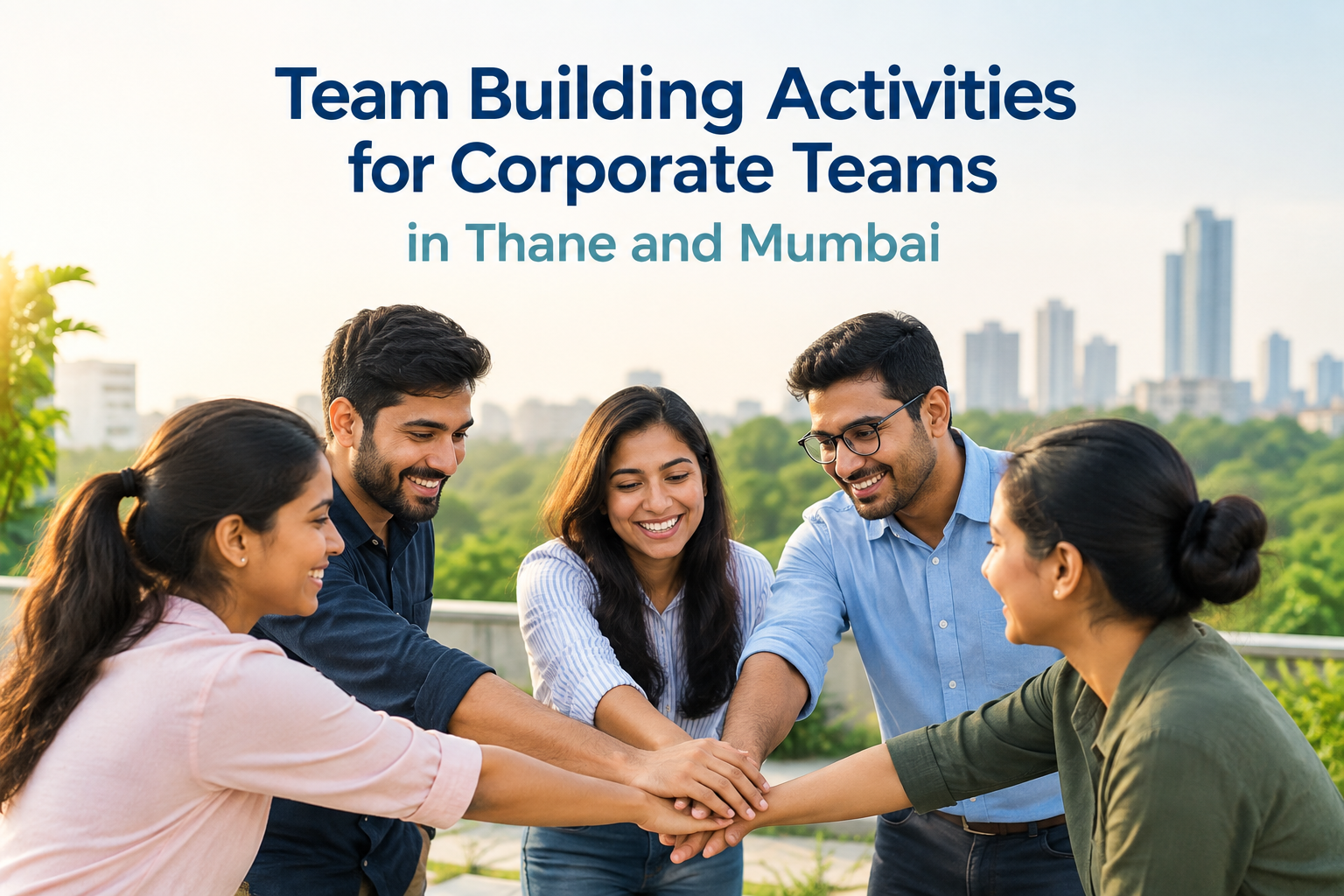
Great teams are built through trust, communication, collaboration, and a shared sense of purpose. The right team building program gives employees an opportunity to step away from routine work, understand how they work together, and develop behaviours that can improve collaboration back in the workplace.
For organizations in Mumbai and Thane, team building can take many forms, from indoor collaboration workshops and problem-solving challenges to leadership simulations and full-day or two-day outbound programs. The most effective approach is not simply to choose an entertaining activity. It is to select an experience that matches the team’s challenges, business objectives, and desired outcomes.
KSM’s team building programs are designed around the specific needs of each organization rather than relying on generic, off-the-shelf workshops. As an experienced team building trainer, Kuldeep Manhas combines experiential learning, practical facilitation, and reflection to help teams build stronger working relationships, improve collaboration, and create better alignment.
Why Team Building Matters for Corporate Teams
Workplace challenges are not always caused by a lack of technical skills. Teams can struggle because of communication gaps, departmental silos, unclear ownership, low trust, or difficulty handling differences of opinion. A well-designed team building experience can bring these behaviours into focus in a practical setting.
For example, a problem-solving activity may reveal how quickly a team shares information, delegates responsibility, listens to different viewpoints, and makes decisions under pressure. A collaboration exercise can highlight whether people naturally work across roles or remain focused only on their own responsibilities. The value comes from connecting those observations to everyday work.
Effective team building can help organizations work toward:
- Better communication between team members
- Stronger collaboration across functions
- Greater trust and openness
- Improved problem-solving and decision-making
- Better understanding of individual and team roles
- Stronger leadership and participation
- Greater team alignment
- A more connected workplace culture
How to Choose the Right Team Building Activity
There is no single activity that works equally well for every organization. The right choice depends on what the team needs to improve.
Team Challenge | Suitable Team Building Approach |
Communication gaps | Communication and listening exercises |
Low trust | Trust and relationship-building activities |
Departmental silos | Cross-functional collaboration challenges |
Weak problem-solving | Structured problem-solving activities |
Leadership gaps | Leadership and strategy simulations |
New or newly formed teams | Team alignment and collaboration activities |
Low engagement | Experiential and interactive activities |
Need for stronger team alignment | Facilitated collaboration workshops |
Before selecting an activity, organizations should consider the team’s size, participant profile, time available, work environment, desired level of physical activity, and most importantly, the behaviour or business challenge they want to address.
Indoor Team Building Activities for Corporate Teams
Indoor team building is useful when an organization wants a structured experience that can be conducted at an office, conference room, training venue, or hotel. It also makes it easier to combine activities with discussion, reflection, leadership development, and workplace learning.
1. Collaborative Problem-Solving Challenges
Problem-solving challenges require participants to work together toward a common objective. Teams may have limited information, resources, or time and must decide how to approach the challenge. These activities can reveal how employees communicate, distribute responsibilities, listen to ideas, manage disagreements, and make decisions.
The important part is not simply completing the challenge. A facilitated discussion afterward helps participants connect what happened during the activity with situations they experience at work.
2. Communication and Listening Exercises
Communication exercises help participants understand how information can become unclear when people make assumptions, listen selectively, or fail to clarify expectations.
A well-designed exercise can demonstrate the importance of:
- Active listening
- Asking relevant questions
- Clarifying expectations
- Sharing information clearly
- Giving and receiving feedback
These activities are particularly useful for teams where communication gaps are affecting collaboration or execution.
3. Cross-Functional Collaboration Activities
When employees from different departments work together, they may have different priorities, terminology, responsibilities, and ways of measuring success. Cross-functional team building activities create an opportunity for participants to understand these differences and work toward a shared objective.
The experience can help teams explore questions such as:
- How do different functions contribute to the same business goal?
- Where do communication gaps occur?
- How can teams coordinate more effectively?
- What information does each function need from others?
KSM Training & Strategy specifically includes cross-functional team alignment within its team building and outbound offerings.
4. Leadership and Strategy Simulations
Leadership simulations place participants in situations where they need to make decisions, allocate resources, manage competing priorities, or respond to changing circumstances.
These experiences can help participants observe leadership behaviours in action.
They can also support discussions around:
- Decision-making
- Delegation
- Influence
- Strategic thinking
- Accountability
- Team leadership
- Handling uncertainty
Leadership simulations can be particularly useful when team building is being integrated with a wider leadership development initiative.
5. Team Alignment Workshops
A team may have capable individuals but still struggle when everyone is working toward a different interpretation of the goal. Team alignment workshops can help participants clarify expectations, responsibilities, communication practices, and shared objectives.
Instead of focusing only on getting people to know each other, the discussion moves toward how the team should work together after the session.
Outdoor Team Building Activities for Corporate Teams
Outdoor programs introduce movement, new environments, and unfamiliar situations into the learning experience. They can be useful for teams that need a change from their usual workplace environment or want a more immersive experience. However, outdoor team building should not become a physical competition where only the most athletic participants can contribute.
The activity should be designed so that different strengths—planning, communication, creativity, leadership, observation, coordination, and decision-making—have a role.
1. Outbound Team Building Challenges
Outbound programs take teams into a different environment where participants must work together to complete a series of challenges. The change in setting can help employees step away from their usual roles and observe different aspects of their colleagues’ working styles. KSM Training & Strategy offers full-day and two-day outbound programs as part of its team building and experiential learning services.
2. Team Problem-Solving Challenges
Outdoor problem-solving activities can involve multiple stages, limited resources, time constraints, or changing conditions. Participants need to decide who will lead, how responsibilities will be divided, what information needs to be shared, and how the team will respond when an initial plan does not work. These experiences can make teamwork behaviours visible in a way that a traditional classroom discussion may not.
3. Leadership and Strategy Challenges
Outdoor environments can provide realistic situations where participants need to plan and adapt. A team may begin with one strategy and discover that it needs to change as the challenge develops.
This provides useful opportunities to explore:
- Strategic thinking
- Adaptability
- Leadership
- Decision-making
- Communication
- Resource management
- Accountability
4. Team Collaboration Challenges
Collaboration challenges are designed around a shared objective rather than individual performance. The goal is to create situations where participants have to depend on one another, exchange information, coordinate actions, and make collective decisions. The experience can be especially valuable for teams that need to improve cooperation across roles or departments.
Team Building Activities for Different Corporate Needs
The best team building activity is the one that addresses a genuine need.
For Better Communication
Choose activities that require participants to listen carefully, clarify information, communicate under time pressure, and give constructive feedback.
For Building Trust
Use experiences that encourage openness, reliability, mutual support, and shared responsibility.
For Improving Collaboration
Select activities where success depends on participants combining different skills and working toward one common outcome.
For Developing Leadership
Leadership simulations and decision-making challenges can help participants practise delegation, influence, accountability, and strategic thinking.
For Breaking Departmental Silos
Cross-functional challenges can help employees understand how their decisions affect colleagues in other functions.
For New Teams
Team alignment and collaborative activities can help newly formed groups establish working relationships and understand how each person contributes to the team.
For Employee Engagement
Interactive and experiential activities can create energy while giving employees opportunities to participate, contribute, and connect outside their normal work routines.
Indoor vs Outdoor Team Building: Which Is Better?
Neither format is automatically better. The right option depends on the team’s objective and the type of experience you want participants to have.
Indoor Team Building | Outdoor Team Building |
Controlled environment | More immersive environment |
Easier venue logistics | Requires more logistical planning |
Suitable for focused workshops | Suitable for experiential programs |
Useful for communication exercises | Useful for collaborative challenges |
Suitable for leadership simulations | Suitable for outbound experiences |
Easier to combine with presentations and reflection | Provides a change from the regular workplace |
Can work well for shorter sessions | Often suited to longer programs |
For example, an organization dealing with communication or leadership challenges may benefit from a focused indoor intervention. A team that needs to reconnect, collaborate differently, or step away from a routine work environment may benefit from an outdoor or outbound experience.
How KSM Designs Team Building Programs
A successful team building program begins before the first activity. At KSM Training & Strategy, the approach starts with understanding the organization’s actual needs. The website describes this as an in-depth need-gap discovery process, followed by custom-built programs rather than generic workshops. The process can be understood through five stages.
1. Understand the Team’s Current Challenge
The first step is to understand what the organization wants to improve. Is the issue communication? Collaboration? Trust? Leadership? Alignment? Or is the organization looking to help a new team establish stronger working relationships?
2. Define the Desired Behaviour
Once the challenge is understood, the desired change needs to be clear.
For example, a team may want employees to:
- Communicate information earlier
- Listen before responding
- Take greater ownership
- Collaborate across functions
- Make decisions more effectively
- Handle differences constructively
3. Select the Appropriate Experience
The activity should support the intended behaviour. A problem-solving challenge may be appropriate for collaboration. A leadership simulation may be better for decision-making and delegation. An outbound program may be suitable when a team needs an immersive shared experience.
4. Facilitate and Observe
The facilitator plays an important role during the activity by observing team behaviour and helping participants notice patterns. The objective is not to tell participants what they should have done. It is to help them understand what happened and why.
5. Connect the Learning to the Workplace
The final step is connecting the experience to everyday work. Participants should leave with a clearer understanding of what they can do differently in meetings, projects, customer interactions, cross-functional work, and leadership situations. This approach reflects KSM’s broader focus on experiential learning, coaching-led development, and measurable outcomes.
What Makes a Team Building Program Effective?
A successful team building program is more than a collection of games. Several factors influence its effectiveness.
A Clear Objective
Participants should understand why they are taking part and what the organization wants to achieve.
Meaningful Participation
Activities should give different types of participants an opportunity to contribute. A good program should not depend only on the loudest, most senior, or most physically active people.
Professional Facilitation
The facilitator should know when to intervene, when to observe, and how to turn an activity into a meaningful learning experience.
Reflection and Debrief
The activity creates the experience. The debrief creates the opportunity to understand it. Participants can discuss what happened, how decisions were made, where communication worked or failed, and what they would do differently at work.
Workplace Application
The most useful question after a team building activity is: “What will we do differently when we return to work?” Without this connection, the experience may be enjoyable without creating meaningful behavioural learning.
Common Mistakes Companies Make When Planning Team Building
Choosing Activities Without a Clear Purpose
An activity may be entertaining but still fail to address the team’s actual challenge.
Focusing Only on Fun
Fun can be an important part of team building, but it should support the learning objective rather than replace it.
Ignoring the Debrief
Without reflection, participants may remember the activity but miss the workplace lesson behind it.
Making Activities Too Competitive
Competition can create energy, but excessive competition can work against collaboration and inclusion.
Choosing Activities That Exclude Participants
Physical ability, age, personality, role, and comfort levels can vary significantly within a corporate group. Activities should provide meaningful ways for everyone to participate.
Treating Team Building as a One-Time Fix
A team building program can create awareness and momentum, but workplace behaviours are reinforced through everyday leadership, communication, meetings, feedback, and accountability.
How Do Companies Measure the Results of Team Building?
Team building outcomes can be assessed by looking beyond participant satisfaction.
Organizations can track changes in areas such as:
- Communication behaviours
- Cross-functional collaboration
- Team participation
- Ownership and accountability
- Manager observations
- Team feedback
- Decision-making practices
- Agreed behavioural commitments
- Follow-up implementation
For example, if the purpose of a program is to improve cross-functional collaboration, the organization can identify specific behaviours that should change and review those behaviours with managers after the program. The measurement approach should therefore be connected to the original objective of the team building intervention.
Team Building Trainer in Mumbai and Thane
Choosing a team building trainer in Mumbai or Thane is not simply about finding someone who can conduct activities. The facilitator should understand workplace dynamics and be able to connect the experience with the team’s actual challenges.
Kuldeep Manhas is a corporate trainer and consultant specializing in sales training, leadership development, and team performance improvement. His experience spans sectors including IT, ITES, manufacturing, BFSI, pharmaceuticals, healthcare, FMCG, insurance, and other business environments.
His approach combines practical business experience with experiential learning, coaching, and customized program design. KSM specifically emphasizes that programs are built around an organization’s needs rather than delivered as generic workshops.
This makes the approach suitable for organizations looking for team building training that connects activities with communication, collaboration, leadership, alignment, and workplace behaviour.
Why Choose a Customized Team Building Program?
Every team has a different working environment. A newly formed startup team may need to establish communication norms. A growing organization may need stronger cross-functional collaboration. A sales team may need greater alignment and accountability. A leadership group may need to work on decision-making and strategic collaboration. A standardized activity cannot always address these differences.
A customized program allows the facilitator to consider:
- Organizational objectives
- Team structure
- Participant roles
- Current workplace challenges
- Group size
- Available time
- Indoor or outdoor setting
- Desired level of physical activity
- Expected behavioural outcomes
KSM’s broader training model follows this customized approach, beginning with understanding the gap before building the learning intervention.
FAQs
What are the best team building activities for corporate teams in Mumbai?
The best team building activities depend on the organization’s objective. Communication exercises, problem-solving challenges, collaboration workshops, leadership simulations, and outbound experiences can all be effective when they are designed around specific team needs such as trust, communication, alignment, or collaboration.
What are some indoor team building activities for employees?
Indoor options can include collaborative problem-solving challenges, communication exercises, team alignment workshops, cross-functional activities, decision-making exercises, and leadership simulations. These formats are useful when organizations want structured learning in an office, conference room, hotel, or training venue.
What are some outdoor team building activities for corporate teams?
Outdoor team building can include outbound challenges, collaborative problem-solving activities, leadership simulations, strategy-based challenges, and other experiential activities. The program should be designed so participants with different abilities and working styles can contribute meaningfully.
How do I choose the right team building activity for my team?
Start with the outcome you want to improve rather than the activity itself. Identify whether the team needs better communication, trust, collaboration, leadership, problem-solving, or alignment. Then choose an experience that gives participants an opportunity to practise and reflect on those behaviours.
How long should a corporate team building program last?
The ideal duration depends on the objective, group size, activity format, and whether team building is being conducted as a standalone intervention or as part of a larger training program. Short focused sessions can address specific behaviours, while full-day or two-day outbound programs allow more time for multiple activities, reflection, and team development.
Can team building activities improve communication and trust?
They can support improvements in communication and trust when the activities are purposeful and professionally facilitated. The learning becomes more useful when participants reflect on what happened during the activity and identify specific behaviours they can apply in their workplace.
Build a Stronger, More Collaborative Team
Team building is most valuable when it goes beyond a single enjoyable day and becomes an opportunity to understand how people communicate, collaborate, lead, make decisions, and support one another.
Whether your organization is looking for an indoor collaboration workshop, a problem-solving challenge, a leadership simulation, or a full-day or two-day outbound experience, the right program should begin with your team’s actual needs.
KSM Training & Strategy can design a team building experience around your organization’s objectives, team dynamics, and desired outcomes.
Ready to plan a team building program for your organization? Connect with KSM to discuss your team’s requirements.